Fire-resistant fencing in San Diego: the complete homeowner's guide
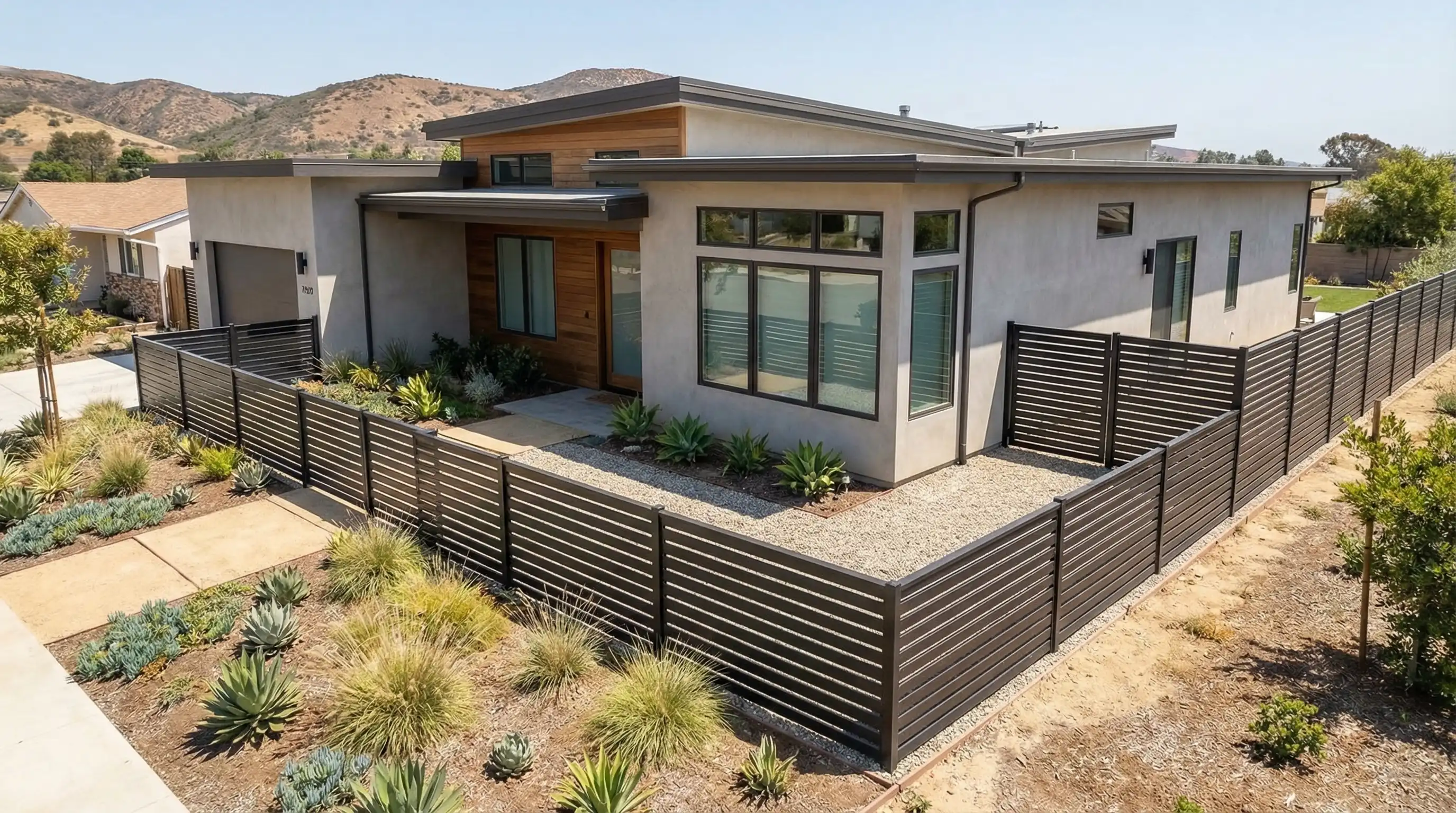
Keep the first 5 feet of fence next to the house non-combustible: aluminum, steel, or masonry. Wood, vinyl, and most composites belong on runs farther out. In the City of San Diego, Fire-Rescue Standard D-2 already requires non-combustible fences and gates, with one narrow exception, within 5 feet of new homes in a Very High Fire Hazard Severity Zone. The statewide Zone 0 regulation is not in effect as of October 2026.
This guide covers how Zone 0 changes fence decisions near the house, which materials are treated as non-combustible, where fences most often carry fire to a structure, and what still needs local verification before final design or contract decisions.
How to choose the right near-structure material
Quick Answers
Near-house material
For many San Diego homes, aluminum is often the most practical non-combustible option within the first 5 feet, though site conditions, privacy needs, and local review can change the right answer.
What changes fastest by address
Zone 0 enforcement and permit expectations can vary by jurisdiction and parcel.
What “fire-resistant fencing” means in practice
No fence removes every fire risk. In real projects, “fire-resistant fencing” usually means choosing materials and connection details that reduce ignition risk and do not create an obvious fuel path into the structure.
For near-structure runs, the practical target is usually non-combustible material. Aluminum, steel, masonry, and stone-based systems are common examples. Combustible options such as wood, vinyl, and many composites can still be appropriate in some parts of a property, but they may be a poor fit where Zone 0 expectations apply.
The main safety concept is simple: avoid giving fire a continuous path from fence line to house.
A practical order of operations
Check the map
Confirm whether the parcel falls in SRA or local VHFHSZ.
Measure the near-house runs
Identify fence sections that sit within the first 5 feet of the structure.
Verify locally
Confirm the final detail expectations with the AHJ before signing off on material choices.
California’s defensible space framework and why it affects fences
California defensible space rules in PRC 4291 are the baseline many homeowners hear about first. The first five feet around the structure (Zone 0) matters most for fencing because this is where ember ignition risk is highest and where material choices are often scrutinized most closely.
Zone 0 (0-5 feet): highest priority near the structure
Zone 0 focuses on reducing ignition opportunities immediately around the home. If fencing touches or closely approaches the structure in this band, non-combustible material is often the conservative path.
How this is interpreted can still vary by jurisdiction and inspection context. That is why local AHJ confirmation is part of every practical planning sequence.
Zone 1 (5-30 feet): manage fuel, spacing, and maintenance
Zone 1 usually emphasizes vegetation spacing, fuel reduction, and ongoing maintenance. Fence selection still matters, but attention typically shifts from direct structure attachment risk to overall fuel continuity across the yard.
Zone 2 (30-100 feet or to the property line): reduce intensity before it reaches the home
Zone 2 is generally about lowering fuel load so fire behavior is less intense closer to the structure. Fencing choices here are still relevant, especially on long runs that connect toward Zone 1 and Zone 0.
Need help planning a fire-resistant fence project?
We can help you sort through Zone 0 priorities, materials, and site-specific constraints without overpromising what your parcel requires.
Book a Site ReviewAB 3074 and Zone 0: where the rules stand in October 2026
AB 3074 established the legal framework for the ember-resistant zone and directed the Board of Forestry to write Zone 0 standards. What applies to your fence depends on who governs the parcel:
- Statewide: the Board adopted Zone 0 rules as emergency regulations on August 19, 2026, then withdrew them from state review on September 8, 2026. As of October 2026 they are not in effect. As the Board summarized the withdrawn package, no combustible fence or gate could attach to an occupied structure, and no new combustible fences or gates would be allowed within Zone 0.
- City of San Diego: SDMC §512.0604 defines Zone 0 as the 5 feet around the exterior wall, deck, or attachment. It applies to new structures that applied for a building permit on or after February 28, 2026, and to existing structures one year later. Fire-Rescue Standard D-2 requires every new fence and gate in Zone 0 of a new structure in a Very High Fire Hazard Severity Zone to be non-combustible, such as steel, aluminum, fiber cement board, or masonry. Its one exception allows qualifying fire-retardant-treated wood that runs parallel to the house at least 4 feet away, with a non-combustible section where it attaches. The city’s Zone 0 guidelines for existing structures ask owners to attempt full compliance, including replacing fences and gates that do not comply, by February 28, 2029.
- Other cities and the unincorporated county: local fire codes and fire authorities set their own terms. See San Diego County fence rules by jurisdiction.
Even where the rule is written down, parcel-level enforcement can move at different speeds depending on map adoption and inspection triggers. Confirm with your AHJ before you lock a design.
Where fences carry fire to a house
Most of the risk sits at a few predictable points:
- The connection to the house. A combustible fence or gate tied into a wall gives fire a direct path to the structure. Both City of San Diego Fire-Rescue documents call for a 5-foot non-combustible transitional span where a fence or gate attaches to the house.
- Corners, gate returns, and the base of the fence. Wind-driven leaves and embers collect where runs meet. A gap between the bottom rail and the ground, kept clear, stops debris from packing against the fence.
- What sits against the fence. Mulch run up to the house, wood furniture stored along a fence line, and dead palm fronds stacked by a side gate can undo a non-combustible fence.
- The gate. A side-yard gate is often the piece closest to the wall. Replacing the fence but keeping a wood gate leaves the most-used section combustible.
Material choices: what tends to be most practical
Most San Diego homeowners evaluating near-house fencing compare four non-combustible paths:
- Aluminum: often the most practical balance of compliance posture, corrosion resistance, and cost for residential runs.
- Steel: strong and non-combustible, but heavier and more sensitive to coating quality and long-term corrosion management.
- Masonry/CMU: robust and non-combustible, often best when privacy or acoustic separation is a top priority.
- Gabion/stone systems: non-combustible and durable, usually selected for specific architectural or grading conditions.
Combustible materials such as wood, vinyl, and many composite products can still appear elsewhere on a parcel, but they warrant extra caution near structures when Zone 0 concerns are in play. A composite board with a Class A or B flame-spread rating under ASTM E84 is still combustible; non-combustible is a separate test, ASTM E136.
Plan the fence in three runs
Walk the property line and sort it into three kinds of run:
- Near-house runs and gate returns within 5 feet of the structure: non-combustible material and a non-combustible attachment.
- Runs along vegetation or open space: non-combustible material is the conservative choice, with enough clearance at the base to keep it clean.
- Privacy runs farther out: material can follow privacy, look, and budget, within local rules.
Many plans end up hybrid: aluminum or steel near the house and at the gates, and a different material farther out where the site allows it. Material changes read cleanly at posts, corners, or grade changes.
San Diego conditions that change the specification
- Salt air. On coastal lots, from Point Loma to Encinitas, finish and hardware decide how long a metal fence looks right. Aluminum does not red-rust; steel should be galvanized under the powder coat, and hinges and fasteners should resist corrosion.
- Canyon edges and slopes. Lots that back onto open space, such as canyon-edge lots in Scripps Ranch, see more embers and more wind. Solid panels catch wind like a sail, post depth has to suit the soil, and panels may need to step or rack to follow the grade.
- Inland heat. Composite expands more than metal and can fade. Ask how the product handles expansion gaps and color stability.
- HOA review. Some associations still list wood or vinyl as the standard fence. A product data sheet showing the fire classification, plus the current Zone 0 status, makes the request concrete.
What inspections typically focus on
Inspection details vary by AHJ, but fence-related review usually comes back to the points above: the material near the structure, the connection detail, debris along the fence line, and gates or stored items that put combustible material back next to the house.
Inspections may occur in several contexts, including compliance programs, transactions, complaint response, or post-incident review. This is another reason to verify current expectations locally rather than rely on a single generalized checklist.
Insurance and documentation reality
Installing non-combustible fencing does not guarantee premium reductions or policy outcomes by itself. It is usually one part of a broader wildfire-hardening profile that some carriers evaluate.
The practical move is documentation: keep product specs, photos of near-structure details, and any permit or inspection records tied to the final installation.
Cost planning for San Diego projects
Project cost usually depends on material, linear footage, terrain, access, gate complexity, and demolition requirements for existing fencing.
In many residential scenarios, aluminum is the lower-friction non-combustible option from both install and maintenance perspectives. Masonry, steel, and gabion systems can be excellent fits when site or design goals justify the additional complexity.
For budgeting, treat generic online ranges as directional only and scope your parcel-specific constraints early.
Timing: plan before peak fire season pressure
The best time to replace high-risk near-house fence sections is before seasonal demand spikes and before late-season fire pressure. Early planning also gives you more time to confirm jurisdiction-specific requirements without rushing material decisions.
Sources & What To Verify Locally
California wildfire rules are real, but parcel-level enforcement can still vary by jurisdiction and inspection context.
- Confirm whether your property falls in an area where Zone 0 enforcement applies today.
- Verify current permit and inspection expectations with your local AHJ.
Frequently asked questions
Do I need to replace every fence on my property right away? Usually, near-structure runs are the first priority. The exact scope depends on location, existing conditions, and local enforcement context.
Is aluminum always the right answer in Zone 0? Not always, but it is often the most practical residential option. Steel, masonry, or gabion may be better for specific privacy, structural, or site conditions.
Can a Class A-rated combustible material be treated the same as non-combustible? Not necessarily. Ratings and material classifications are not interchangeable, and AHJ expectations can differ. Verify before locking a design.
Will my insurer require fire-resistant fencing? Carrier expectations vary. Some evaluate defensible-space improvements as part of broader wildfire risk review, but requirements and pricing impacts are policy-specific.
Do I need permits for a fence replacement? Sometimes. Permit triggers depend on local rules, fence type, location, and scope. Confirm with your jurisdiction before construction.
Comparing fire-resistant fencing options for your San Diego property? Look at non-combustible materials for the near-structure zone, then confirm what applies to your parcel with your local jurisdiction (AHJ).
Verification note (updated March 26, 2026): Regulatory requirements can vary by parcel, jurisdiction, and inspection cycle. Confirm current requirements with your AHJ and official California sources before final design or contract decisions: PRC 4291, Board of Forestry Zone 0 updates, and OSFM FHSZ maps.