Why Your Los Angeles Fence Choice Matters More Than You Think
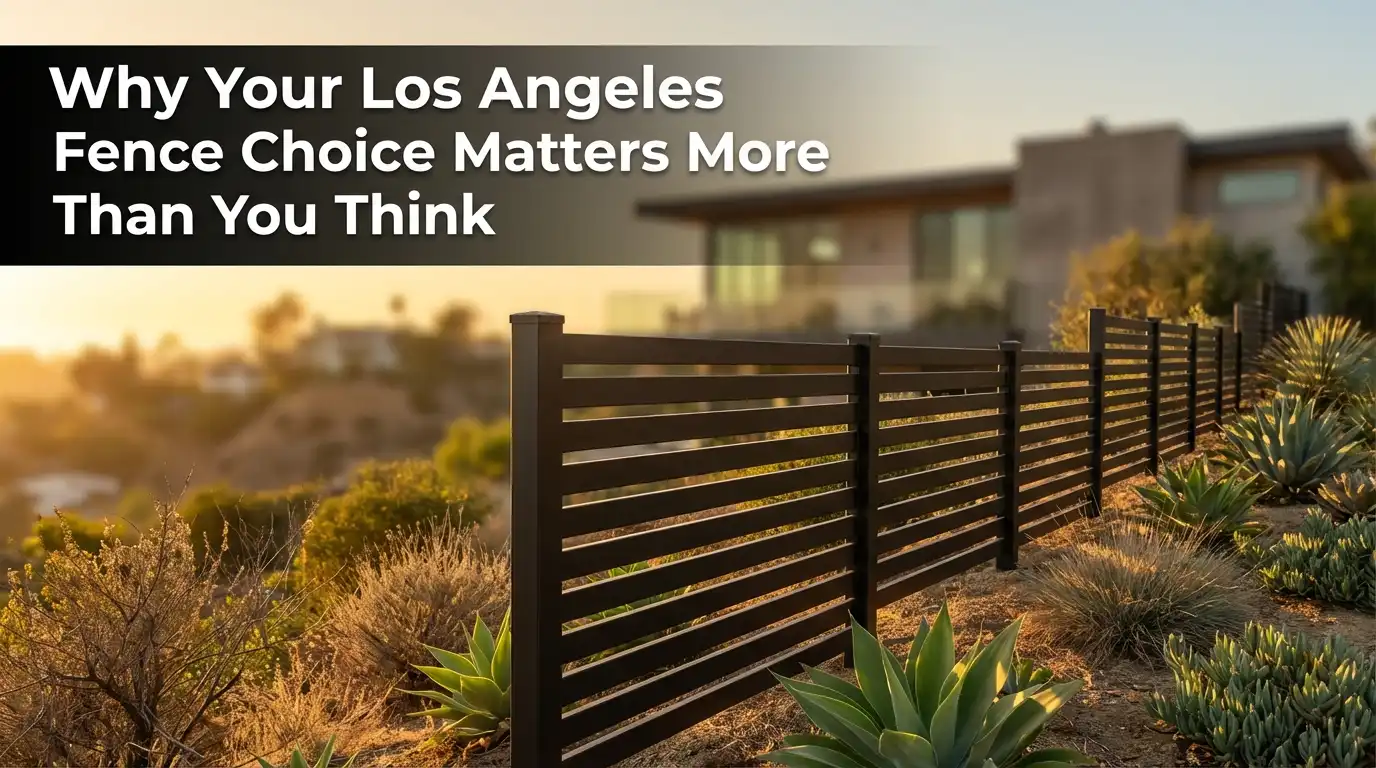
If you own a home in Los Angeles, you’ve probably thought about your fence for privacy, or maybe to keep the neighbor’s dog out. But there’s another thing to think about: fire. Wildfire risk isn’t limited to houses in the hills, and California is writing new rules for the area right next to homes.
This guide covers where those rules stand, which materials make sense near the house, how materials hold up in a place that can go from dry Santa Ana winds to damp ocean air overnight, and what to ask an installer.
Where the Zone 0 rules stand
California’s AB 3074 directed the State Board of Forestry and Fire Protection to write rules for “Zone 0,” the area within five feet of a structure. The Board adopted those rules as emergency regulations on August 19, 2026. The Board withdrew them from state review on September 8, 2026; as of October 2026 they are not in effect.
As the Board’s notice summarized the withdrawn text: had the rules taken effect, no new combustible fences or gates would be allowed in Zone 0, and no combustible fence or gate could attach to the house; a fence that attaches would need a 5-foot non-combustible section at the attachment point. “Non-combustible” is defined by the ASTM E136 test. Existing homes would get 3 years for the fence and gate rules, or up to 5 years if the local fire agency sets a longer timeline.
Where any state Zone 0 rule would apply depends on Fire Hazard Severity Zone mapping, and city and county fire codes can add their own requirements. Check your parcel on CAL FIRE’s map and confirm current rules with the Los Angeles Fire Department or LA County Fire, whichever serves your address. If you’re replacing a fence close to your house anyway, choosing a non-combustible material now avoids redoing it later.
Why metal makes sense near the house
During a wildfire, embers can travel far ahead of the main fire. They land in gutters, on decks, and against wooden fence panels. A wood fence that runs up to your siding gives fire a direct path to the house.
Aluminum and steel don’t burn. No material makes a home immune in a major fire, but a metal section where the fence meets the house removes one of the most direct paths. Composite is combustible, even when a product carries a Class A flame spread rating under ASTM E84, so it belongs farther from the house.
Besides safety, there are practical reasons. A powder-coated aluminum fence won’t warp or crack like wood after years of strong sun. Near the coast, corrosion is the issue: aluminum and properly galvanized, powder-coated steel handle salt air better than bare metal. Metal costs more upfront than wood, but it needs far less staining and repair.
What to look for in an installer
Not every fence company will bring up Zone 0. A good installer will:
- Ask for your address and check your Fire Hazard Severity Zone before recommending a material.
- Explain which sections of your fence are within five feet of a structure, and how gates are handled.
- Give material specifics. “Metal fencing” is too broad. Ask: Is it aluminum, and what alloy? How thick is the powder coat? Is the steel hot-dip galvanized? For composite, which brand and product line, and what fire test documentation exists?
- Tell you whether your project needs a permit from the Department of Building and Safety (LADBS) or another agency, and who will pull it.
Ask to see past work and look at how each fence connects to the house, the gate hardware, and the finish details.
Need a non-combustible fence that still looks residential?
See aluminum fence systems built for coastal durability, clean lines, and fire-aware near-structure transitions.
Explore Aluminum FencingLocal conditions vary
In canyon and hillside areas, the main concerns are wildfire embers and steep, tricky ground. A steel or aluminum fence with posts set deep in concrete suits slopes, and the installer’s plan for access matters.
In the flat parts of the San Fernando Valley, soil and sun are the bigger factors. Clay soils affect how posts are set, and UV resistance of the powder coat or composite color matters over the years. If your parcel is in a mapped fire hazard zone, any statewide Zone 0 rule would apply there too if one takes effect.
Near the ocean, salty, damp air is the biggest issue. Use a high-quality powder coating on aluminum, and hot-dip galvanized steel rather than painted steel.
First steps
- Find your zone. Use CAL FIRE’s Fire Hazard Severity Zone viewer, then check the city or county fire department for local rules.
- Call your insurance agent. Ask: “If I swap my wood fence for a non-combustible material, does that change anything for my policy?” Coverage decisions stay with your insurer.
- Sketch your property. Mark the fence sections within five feet of any outside wall, including attached garages. That is your probable Zone 0 area.
- Gather your questions. Ask about warranties on the materials and on the installation work.
Wrapping up
Picking a fence in Los Angeles has always been about balancing looks, privacy, and price. Fire safety now belongs on that list, and the state’s Zone 0 package, though withdrawn, shows what rules near the house could look like. Start with the maps, get your questions ready, and choose non-combustible material for the sections closest to your home.
FAQ: Fire-Resistant Fencing in Los Angeles
I live in a flat part of the Valley. Do these rules apply to me? They can. State Zone 0 rules, if adopted, would apply based on Fire Hazard Severity Zone mapping, which isn’t just about hills. Use the CAL FIRE map to check your parcel.
Is vinyl fencing a good fire-resistant option? Usually, no. Vinyl (PVC) can burn and melt, and it is not non-combustible, so it would not meet a Zone 0 non-combustible standard.
How much more does an aluminum fence cost than a wood fence? Aluminum costs more upfront than basic wood. The difference depends on the style, height, and your site. Lower maintenance offsets part of that over time.
Can I just replace the section of my wood fence that’s within five feet of the house? That is a common approach, often called a “hybrid” or “split-material” fence. The Zone 0 section uses non-combustible material, and the rest of the run can stay as is. Confirm the details with your local fire authority.
Who pulls the permit, me or the contractor? If a permit is needed, a licensed contractor typically pulls it. Owner-builder permits are legal, but if a contractor asks you to pull one to “save money,” ask why.
Verification note (updated March 26, 2026): Regulatory requirements can vary by parcel, jurisdiction, and inspection cycle. Confirm current requirements with your AHJ and official California sources before final design or contract decisions: PRC 4291, Board of Forestry Zone 0 updates, and OSFM FHSZ maps.