Salt Air and the Marine Layer
Onshore wind and the morning marine layer carry salt well past the sand, and it sits on a fence for hours. Finish, fasteners and every place two metals meet matter more here than ten miles inland.
The five rules most Encinitas fence plans start from, each linked to its source.
Bluff setbacks, coastal permits and specific plans are covered in the questions below and in Encinitas fence rules in our county guide. For fire mapping on an address, try the Zone 0 checker.
Aluminum handles the open-top allowance in one fabricated panel: tight below, open above.
Onshore wind and the morning marine layer carry salt well past the sand, and it sits on a fence for hours. Finish, fasteners and every place two metals meet matter more here than ten miles inland.
Edges bring setbacks and grade that changes along a run. Where a fence stands above a retaining wall, the City’s handout sets it 4 ft back from the wall, unless it is a qualifying railing or glass panel (PLN-196).
In Leucadia and Cardiff a side yard may leave room for one gate and a bin path. In Olivenhain it flips to long property lines and gates used with a horse on a lead, and animal enclosures such as corrals stay at least 35 ft from a dwelling on an adjacent lot (EMC § 30.55.030).
For lots near the water, powder-coated aluminum is the usual starting point; it doesn’t form red rust. Farther inland, steel carries long runs and heavier gates.
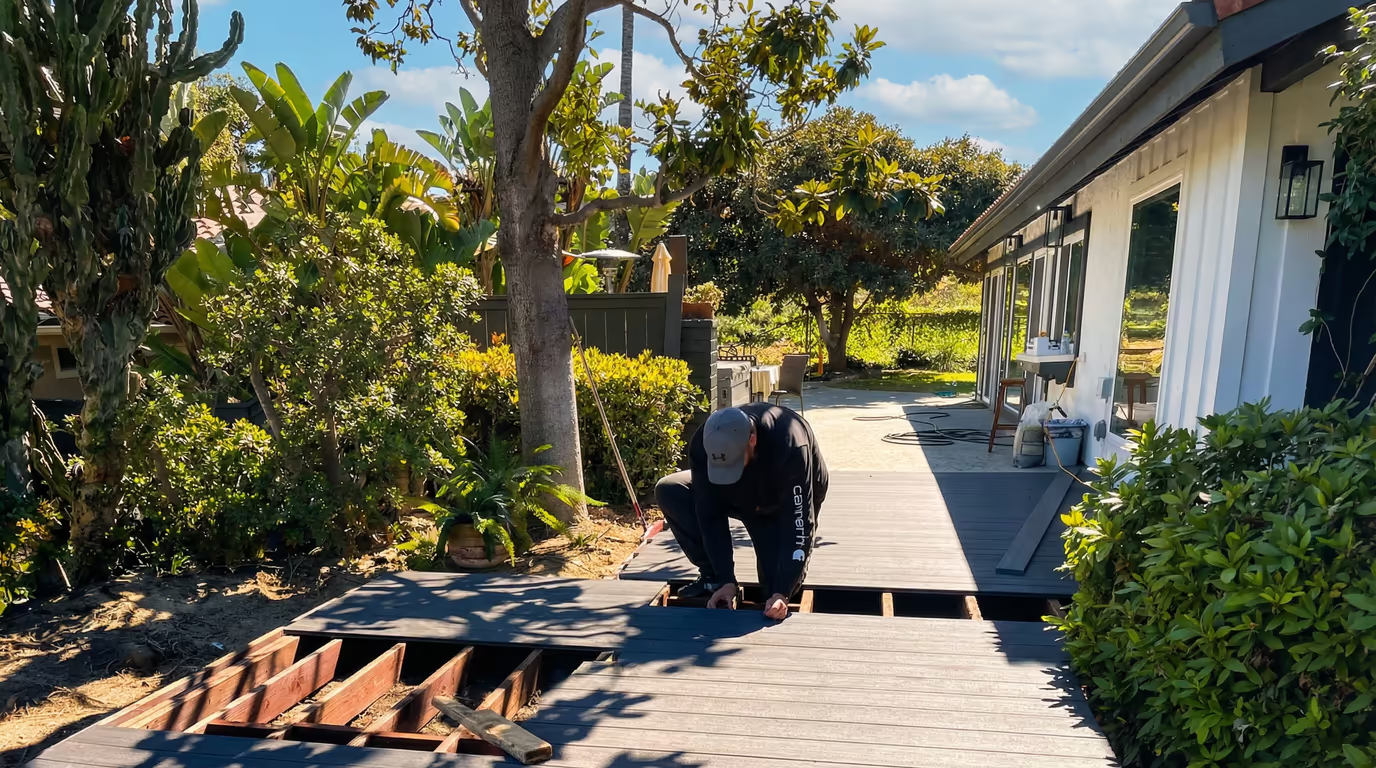
We are not taking deck projects at the moment, but this one is real Encinitas work: an aging wood deck removed and replaced with a composite deck, with the boards fastened the way the manufacturer requires.
A typical project moves through five steps. The City has the final say on permits.
We walk the line with you and look at grade, edges and side yards.
Heights, material, finish, hardware and gate swings.
Panels, posts and gates made to the measured runs.
Posts set, panels installed, gates hung and adjusted.
We walk the finished work with you.
With limits. On a bluff-top lot, walls and fences stay at least 5 ft from the bluff edge (PLN-196), and the Coastal Bluff Overlay generally keeps structures 40 ft back, allowing only minor at-grade work that needs no City permit within 5 ft (EMC § 30.34.020). Confirm with Planning before design.
It can. Most of the city lies in the Coastal Zone, where development needs a coastal development permit unless exempt, and the exemption is lost when a discretionary approval is needed, such as for a fence over 6 ft, or when the Coastal Bluff Overlay applies (EMC Ch. 30.80).
They can. The Cardiff-by-the-Sea, Downtown, North 101 Corridor and Encinitas Ranch specific plans may set their own residential standards, and homes in a Planned Residential Development may face limits on fence colors and materials. We haven’t reviewed those plans’ fence standards, so confirm with Planning (760-633-2710) or your HOA.
Each neighboring city has its own fence rules.
Near the water, on a bluff-top street or in Olivenhain, we’ll walk the property with you, measure the fence line, then write up the scope.
Most site reviews and estimates are free; we confirm before booking.
Or call (619) 975-1883, weekdays 8am to 6pm.